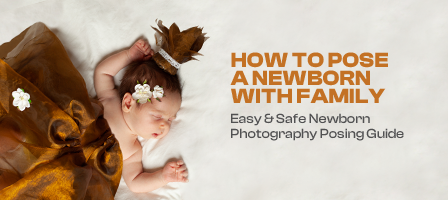
You finally have your newborn home, the golden afternoon light is streaming through the bedroom window, and you think this is the moment. But the second you try to arrange your tiny, squirming baby into a beautiful pose, they startle awake, burst into tears, and the moment dissolves. Sound familiar?
Getting newborn photography poses right is one of the most nuanced skills in portrait photography. Babies cannot follow direction, cannot hold a position, and will let you know loudly when they are unhappy. Yet the poses that emerge from a well-planned, safety-first newborn portrait session are among the most emotionally powerful images a family will ever own.
Whether you are a parent planning a home session or a photographer looking to refine your newborn posing technique, this guide walks you through every essential pose, the safety principles behind each one, and the practical tips that separate good images from extraordinary ones.
The Non-Negotiable Rules of Newborn Posing
Before we explore a single newborn photography pose, we need to establish the foundation every responsible session is built on: safety. Newborns are fragile. Their neck muscles are underdeveloped, their skulls are soft, and their airways can be compromised by seemingly minor positional changes.
Every experienced photographer, including the team at Arjun Shah Photography, follows these rules without exception:
Never leave a posed newborn unsupported or unattended. Even a baby who appears deeply asleep can startle and shift position in a fraction of a second. A spotter, a second adult with hands lightly hovering should be present for every posed shot.
Never force a position. If a baby resists a pose or their body does not naturally fall into it, move on. No image is worth discomfort or risk. The best safe newborn poses work with the baby’s natural resting position, not against it.
Never obstruct the airway. In any pose where the chin drops toward the chest or the nose is pressed against fabric, check that the airway remains fully open. This is the primary safety concern in posed newborn photography.
Composite posing for complex images. The iconic “froggy pose” where the baby appears to rest chin-on-hands is always a composite image created from two separate shots: one supporting the head, one supporting the hands. It is never achieved in a single frame. Attempting it as a single shot is dangerous and should only be performed by trained professionals.
For further guidance on safe sleep positions for newborns, the American Academy of Pediatrics provides authoritative safety guidelines that every photographer and parent should review before any session.
Timing Your Newborn Portrait Session for Posing Success
Even the most skilfully executed newborn photography pose depends on one factor above all others: a sleeping baby. Deep sleep is what makes gentle posing possible, and achieving it requires understanding newborn rhythms.
The golden window is days 5–14 of life. During this period, newborns spend the majority of their day in deep, heavy sleep cycles. Their natural flexibility is at its greatest, and they are not yet alert enough to fight being gently repositioned.
Feed before you pose. A full baby is a sleepy baby. Begin your newborn photo session approximately 20 to 30 minutes after a full feed, once the baby has drifted into deep sleep. You will know they are in a deep sleep state when the limbs go completely limp and they do not stir when you gently lift an arm and release it.
Keep the room warm. Naked or minimally wrapped babies lose body heat quickly, which triggers waking. Maintain the room at 23–24°C (74–75°F) for any unwrapped poses. A small space heater placed safely away from the baby and props can make the difference between a smooth session and a frustrating one.
Work slowly and with intention. Rushed posing wakes babies. Every transition from one baby photography pose to the next should take several minutes, with movements measured in millimetres rather than inches.
The Essential Newborn Photography Poses, Step by Step
1. The Wrap Pose
The wrap pose is the most accessible and consistently beautiful newborn photography pose for both professionals and parents attempting home sessions. A sleeping baby is swaddled snugly in a stretchy jersey or muslin wrap, with the face framed cleanly by the fabric.
How to execute it: Lay the wrap flat on a soft, padded surface near your light source. Place the sleeping baby at the centre and fold the fabric across the body in smooth, firm layers. The key is tension a loose wrap sags and looks untidy in images. Aim for a wrapped shape that resembles a soft cocoon, with the arms tucked naturally across the chest.
Shot angles: Shoot from directly above (flat lay) for a clean, editorial image, or drop to a 45-degree angle to capture the three-dimensional softness of the cocoon shape. Both approaches produce stunning newborn photo ideas with minimal equipment.
Posing variations: Wrap the baby to the chin and leave the feet peeking out the bottom. Alternatively, fold the wrap away from one side of the face to expose a single cheek and ear an angle that captures the delicate profile beautifully.
2. The Beanbag Pose (Taco / Curled)
The beanbag pose is the backbone of posed newborn photography in professional studio settings. A firm, posing beanbag covered with a textured blanket provides the elevated, soft surface that allows for the classic curled newborn positions.
The taco curl: Place the sleeping baby on their back or side in a natural fetal curl. Gently encourage the knees toward the chest most babies will naturally hold this position if they are in deep sleep. This newborn posing style celebrates the natural compact shape newborns hold so briefly in those first days of life.
The side-lying pose: Position the baby on their side with knees gently drawn up, one arm slightly extended and one tucked beneath the cheek. This is a versatile pose that works beautifully both wrapped and unwrapped, and transitions naturally into close-up detail shots of hands, feet, and eyelashes.
Important safety note: When shooting on an elevated surface, a spotter must be positioned with hands at the baby’s back at all times, moving fluidly out of frame for each shot.
3. Parent and Newborn Poses: Skin-to-Skin Connection Shots
Among the most emotionally resonant newborn family poses are those that require virtually no technical setup: a parent holding their newborn close. These parent and newborn poses capture genuine love and scale the vastness of adult hands cradling something so impossibly small in a way that no elaborate prop arrangement ever can.
Chest hold: The parent sits comfortably near the window, shirt partially or fully open. The sleeping baby is placed on the parent’s bare chest, cheek resting against the heartbeat the baby listened to for nine months. Shoot from slightly above and to the side to capture both faces in the frame. This is one of the most requested poses in any newborn portrait session.
Cradle hold: One parent cradles the baby in both hands, lifted slightly toward the camera. Shoot from above, focusing on the baby’s face with the parent’s hands providing a natural frame. For fathers especially, this angle powerfully communicates the size of those hands against a newborn’s body.
Forehead to forehead: A parent leans in to press their forehead gently against the baby’s head, eyes closed. This creates an intimate, meditative image that many families call their favourite from the entire session.
Both parents together: Seat both parents side by side near the window, each with one hand supporting the baby between them. Shoot close and tight, cropping the image below the parents’ chins to make the baby the undeniable focal point of the newborn family pose.
4. Sibling and Newborn Poses
Sibling and newborn poses rank among the most cherished images families ever commission the visual proof of the moment one family dynamic became another. They also require the most planning, patience, and supervision of any newborn photography pose category.
The lap pose: Have the older sibling sit on a sofa or bed with their back against a cushion and legs stretched out. The newborn is placed lying across their lap, gently supported underneath by a parent’s hands just out of frame. Prompt the sibling to look down at the baby that unguarded gaze of wonder is the image you are chasing.
The lean-in: The sibling lies on their stomach beside the baby on a flat surface, propped on elbows, faces close together. This casual, effortless baby photography pose looks completely natural while requiring careful positioning to keep both subjects in the same focal plane.
The big hand, little hand shot: A close-up detail of the older sibling’s hand gently placed over the newborn’s. No faces, no bodies: just two sizes of hand and the story they tell together. This is one of the most powerful newborn photo ideas for families welcoming a second or third child.
Important: Never leave an older child unsupported with a newborn on an elevated surface, even briefly. Have a second adult managing the sibling at all times, keeping the atmosphere playful and calm. Children who are tense or bored produce tense, bored images.
5. Detail Shots: The Poses Everyone Forgets
The most downloaded, most printed, most framed images from many newborn portrait sessions are not the wide family groupings; they are the detail shots. Tiny feet. A hand no bigger than a strawberry. The curve of a sleeping ear.
Detailed newborn photography poses require a macro lens or close-focus prime lens (a 100mm macro or 85mm at minimum focus distance works beautifully), excellent light, and a very still baby. Useful detail shots to plan for:
- Feet stacked: Both feet placed sole-to-sole, toes splayed. Shoot from directly above with a macro lens.
- Hand wrapped around finger: A parent extends one finger; the baby’s reflex grip does the rest. Shoot tight to fill the frame with nothing but those two hands.
- Ear and profile: A lateral close-up showing the ear, the curve of the cheek, the long sweep of newborn eyelashes. This requires a side-lighting position for your baby so the window light rakes gently across the face from the side.
- Sleeping face: Simply the face in peaceful sleep. Shoot from slightly above, at a 30-degree angle, with the light coming from the side. This is perhaps the truest record of your newborn in those first days: nothing staged, nothing manufactured, just sleep and softness.
Lighting for Newborn Poses: The Rule That Changes Everything
Every newborn photography pose is made or broken by the quality of light falling on the subject. For home sessions, natural window light is your greatest asset. For a detailed breakdown of how to set up and maximise window lighting for your session, refer to our companion guide on how to take stunning newborn family photos at home.
The one principle to anchor your entire lighting approach: light should sculpt, not flatten. Position your light source to the side of your subject rather than directly in front. Side-lighting creates shadow that gives dimension to every pose the gentle curve of a wrapped baby, the relief of tiny knuckles, the depth of a newborn’s sleeping expression.
What to Do When Things Don’t Go to Plan?
Even with perfect preparation, newborns are unpredictable. Here is how experienced photographers navigate the most common session challenges:
Baby won’t settle into sleep: Stop trying to pose. Hold the baby upright on your shoulder and walk slowly. The rhythmic movement, warmth, and heartbeat proximity almost always triggers drowsiness within 5–10 minutes. Then try again.
Baby cries during posing transitions: This is normal and expected. Return to feeding or soothing immediately never attempt to push through a crying baby into a pose. The images you get will reflect the distress, and more importantly, the baby’s comfort comes first.
Poses keep falling apart: Check the room temperature first. A cold baby is a restless baby. Then check your posing pace, slowing down dramatically often solves the problem entirely. The most beautiful newborn posing sessions are the unhurried ones.
When to Hire a Professional for Newborn Posing?
Home sessions and DIY posing produce wonderful candid memories. But for technically complex newborn photography poses, composite froggy poses, elaborate prop setups, and multi-person family groupings, there is no replacement for a trained specialist who has spent hundreds of hours learning to read newborn body language, work quickly and safely, and make every member of the family feel at ease.
At Arjun Shah Photography in Vancouver, every newborn portrait session is designed around your family’s comfort and your baby’s safety first, with the technical craft following close behind. If you are expecting and want to secure that first-week window, reaching out during your second trimester gives us the best chance to plan something truly exceptional together.
Conclusion
After hundreds of newborn photo sessions, the images that consistently move parents to tears are rarely the technically most complex. They are the ones that feel most true a baby’s ear pressed against a parent’s chest, two siblings sharing one impossible gaze of recognition, a tiny hand wrapped around a finger and refusing to let go.
The newborn photography poses in this guide are tools, not rules. Use them as a foundation, stay flexible, and always follow your baby’s lead. When the light is right, the baby is settled, and the room is quiet, what emerges in front of your camera will be more beautiful than anything you could have planned.
Start preparing early, keep safety at the centre of every decision, and if the moment calls for it, trust a professional to capture the image you will hang on your wall for the rest of your life.
FAQs
1. What is the safest newborn photography pose for a home session?
The safest and most accessible newborn photography pose for home sessions is the wrap pose of a snugly swaddled baby lying on a flat, padded surface near a window. It requires no elevated surfaces and produces consistently beautiful results.
2. When should I schedule a newborn portrait session?
The ideal time is within the first 5 to 14 days of life. Babies sleep most deeply during this window, making gentle posing possible. Book your photographer during your second trimester to secure availability.
3. Is the froggy pose safe?
The froggy pose is safe when performed by a trained professional using composite photography it is never achieved in a single shot. It should not be attempted at home without professional training and supervision.
4. How do I keep my baby asleep while posing?
Feed the baby 20–30 minutes before the session begins, keep the room warm (23–24°C), and work slowly. Transition between poses in small, gradual movements to avoid startling the baby awake.
5. Can siblings be included in newborn photography poses?
Yes, sibling shots are some of the most treasured images from any newborn session. Always have a second adult supervising the older child, and keep the atmosphere calm, fun, and pressure-free for the best results.